.svg)
.avif)
AEO maturity model
Answer Engine Optimization is the practice of structuring a website so AI systems like ChatGPT, Perplexity, and Google AI Overviews can extract and cite it accurately. Webflow is unusually well positioned for that work, because the three things answer engines reward most, semantic markup, consistent content structure, and controllable schema, are platform features rather than plugins you bolt on.
In June 2026 Webflow made that position explicit by publishing its AEO Maturity Model. Here is what the framework says, and what it looks like when you actually run it.
Why does AEO matter more than classic SEO right now?
AI search traffic is a real business driver and it is growing. A 2026 Ahrefs study of 300,000 keywords found that an AI Overview on position one cuts click through rate by 58%.
Read that number carefully. The clicks are not disappearing. They are going to whoever the AI decides to cite.
The counterintuitive part is that the traffic you do get is better. Two 2026 studies found that LLM visitors convert between 4.4x and 23x more than typical SEO traffic. Volume down, qualification up. That is the trade, and it only works if you are the source being cited.
Most teams are not ready. Our analysis of AI website readiness in 2026 found that 73% of companies hit technical obstacles when adapting their sites for AI. Some have already hired AEO specialists. Others still treat AEO as SEO with a new name, and assume good rankings will carry them across.
They will not.
What is Webflow's AEO Maturity Model?
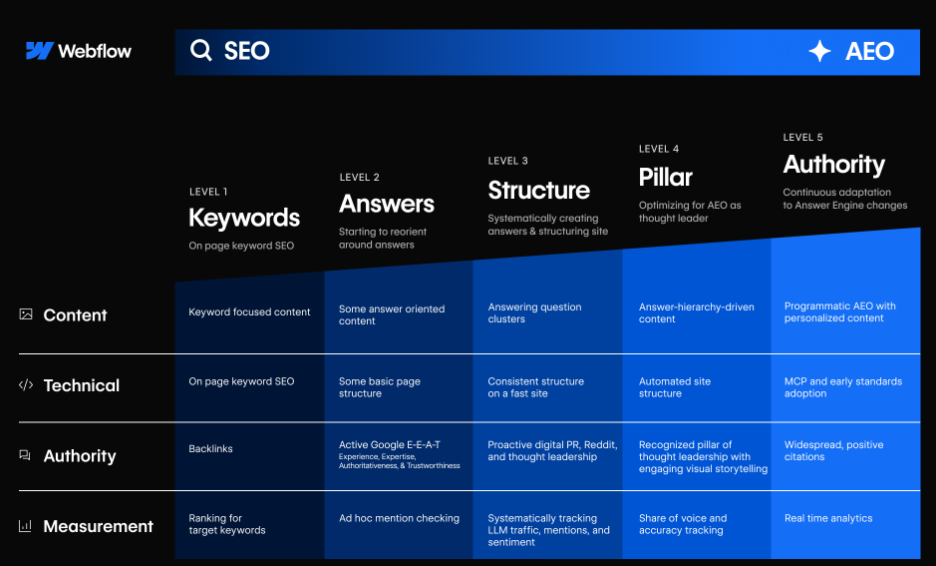
Webflow's AEO Maturity Model, published by Chief Evangelist Guy Yalif in June 2026, breaks AEO into four categories. You score each one separately.
- Content. From counting keywords to answering the real questions buyers ask. Moving from a collection of keywords to a cluster of questions, then to content personalized by segment.
- Technical. From basic SEO to explicit site structure, schema.org markup, and speed. Webflow notes that 88% of sites still have no schema markup, while 73% of first-page Google results use it.
- Authority. From backlinks to widespread, positive mentions. Podcasts, speaking, and presence on the platforms AI systems weight heavily.
- Measurement. From keyword rankings to share of voice inside AI answers, tracked against competitors.
What are the five levels of AEO maturity?
Each category is scored on the same five-level scale.
- Keywords. Search strategy built on brand and main category terms. Visibility only where buyers already know you exist.
- Answers. Content starts answering typical prospect questions in clusters, reaching earlier buying stages.
- Structure. Systematic answers plus auto-generated, AI-friendly site structure so LLMs can parse meaning.
- Pillar. Recognized authority. High-value links and regular AI citations start compounding.
- Authority. Programmatic AEO, continuous adaptation, personalization down to segment and individual.
Most teams are not at one level overall. A typical B2B SaaS marketing team sits at Level 2 on Content and Level 1 on Measurement. Scoring per category is the point of the model.
Webflow has also published how its own team runs this. Their content team automated the refresh process and went from manually updating fewer than 50 articles a year to optimizing dozens every month, with a 40% lift in organic traffic on refreshed content within days. That is one team's result with a specific toolchain, not a benchmark, but it shows what Level 3 throughput looks like in practice.
If you want a lighter starting point, we asked an AEO expert how to get AI to notice your website. His three-level framework is a practical way in before you formalize around the full model.
Why is Webflow the right platform for this?
The headline of this piece is a claim, so here is the argument.
CMS structure. Answer engines reward consistency. Webflow CMS collections let you standardize every field across every item: a dedicated meta description, a summary, question and answer pairs, an updated date. Every article in a collection inherits the same extractable shape. You do not rebuild it per post.
Schema control. Structured data is how you tell an answer engine what a page is, instead of hoping it infers correctly. In Webflow you can bind JSON-LD to CMS field values inside a collection template, so schema generates itself as content publishes. The part most teams miss is connection: entities that reference each other through @id are traversable, and disconnected blocks are not. We wrote up how to run that across a whole CMS, and built Schema HQ to do it at scale.
AI-ready publishing. Webflow's AI-first platform produces clean, LLM-ready code by default. That matters because retrieval happens before citation. A page that cannot be parsed cleanly never enters the running.
Where should you start?
Score yourself on the four categories before you touch anything. Most teams discover they are further along on Content than on Measurement, which changes what to fix first.
Then check whether it is working. We run this on our own site. In the 29 days to August 13 2026, karpi.studio earned roughly 6,200 citations from Bing AI across 49 pages, averaging about 215 a day, up 85% on the month before.
The distribution is the interesting part. Two ranked lists, one of Webflow AEO agencies and one of WordPress to Webflow migration agencies, take about 69% of every citation between them. Almost everything else is granular: 39 of the 49 cited pages are individual schema glossary definitions, and together they account for roughly a quarter of the total. None of them are broad thought-leadership posts. Specific beats broad, every time.
Our approach is to help AI write the right story about our clients, rather than letting it assemble one out of whatever it happens to find.
The full technical method is in the Webflow AEO guide. The done-for-you version is the AEO service page. And if you do not know which of the five levels you are on, that is the more useful question to answer first.
Follow Karpi Studio on LinkedIn for more.


.avif)