.svg)
.avif)
Everyone with a LinkedIn headline is an “AEO expert” now. The label got cheap fast. So here is the honest version: the people actually defining AI search in 2026, the ones whose research, frameworks, and experiments the rest of us cite when we talk about getting brands into ChatGPT, Perplexity, and Google AI Overviews.
This list is curated by contribution, not follower count. Some of these names have huge audiences. Some are quiet engineers running retrieval experiments most marketers will never read. What they share: original work that holds up. We grouped them by what they actually bring, from the people who coined the field to the technical end that explains how the machines pick sources.
Two disclosures up front. Karpi Studio built this list. We kept the main groups to people whose work we cite, not ourselves. At the very end we added a short, clearly-labeled Webflow-native section that does include us and one peer, because that is the lane we work in, and we would rather be open about our stake than pretend we have none. Second, every role and affiliation here was verified as of June 2026, because we are sending each person a copy and we would rather not get a title wrong.
What makes someone an actual AEO authority
An AEO expert is someone whose original work on AI search gets cited by other practitioners and, increasingly, by the AI engines themselves. AEO stands for Answer Engine Optimization: the practice of getting a brand quoted inside AI-generated answers from ChatGPT, Perplexity, Google AI Overviews, and Bing. The field is barely two years old as a named discipline, so authority here is earned the hard way, by publishing data, frameworks, or experiments that other people build on.
That filter matters because the loudest voices and the most useful voices are not always the same people. The list below weighs published contribution over reach. A 4-billion-parameter model trained to reason over a knowledge graph counts for more than a viral thread.
Where the term came from
Worth knowing before the list. “GEO” (Generative Engine Optimization) was coined in a 2024 academic paper, GEO: Generative Engine Optimization by Pranjal Aggarwal and colleagues out of Princeton, presented at KDD 2024. The marketers built the practice, but the researchers named it and ran the first controlled study on what makes content surface in generative answers. Cite the source, not the reseller.
Category-definers
Two people turned AI search from a curiosity into a discipline with a playbook.
Mike King
Founder and CEO, iPullRank.
The closest thing AEO has to a patient zero. King frames AI search as an engineering problem (query fan-out, passage retrieval, embeddings) rather than content with schema sprinkled on top, a discipline he calls Relevance Engineering. His free book is the most substantive open text in the field.
Read: The AI Search Manual (free, roughly 24 chapters).
Follow: LinkedIn · The Rank Report (weekly) · SEO Week.
Ethan Smith
CEO, Graphite.
The experiment-backed operator everyone quotes. Smith’s Graphite published the most rigorous AEO case work anywhere, the Webflow study (LLM-sourced signups doubling to 8%, converting at 24% versus 4% for non-brand SEO) backed by test-and-control groups and p-values. His thesis that LLM traffic converts roughly 6x better than search is grounded in his own client data.
Read: his AEO guide on Lenny’s Podcast and Newsletter.
Follow: LinkedIn · Graphite’s “Five Percent” blog · Reforge.
Data and research voices
The people who supply the evidence the rest of the field cites. When AEO needs a number, it usually comes from one of these five.
Tim Soulo
CMO, Ahrefs.
The biggest datasets in AI search, paired with a deliberately anti-hype stance. Soulo’s Ahrefs studies (ChatGPT versus Google traffic share across tens of thousands of sites, AI Overviews cutting clicks by 58%) are the numbers everyone else quotes. He also ships Brand Radar, a product that measures AEO directly.
Read: the Ahrefs “ChatGPT vs Google” research.
Follow: X @timsoulo · LinkedIn · Ahrefs blog and YouTube.
Kevin Indig
Growth advisor, author of Growth Memo.
The independent analyst-translator. Indig turns UX studies and academic GEO research into operator strategy, publishing original clickstream work on how AI Overviews and AI Mode actually change behavior. Less tactics-lister, more “here is what the data says, and what to do about it.”
Read: “State of AI Search Optimization 2026” (Growth Memo).
Follow: Growth Memo (newsletter) · LinkedIn · X @Kevin_Indig.
Rand Fishkin
Co-founder and CEO, SparkToro.
The data backbone of why AEO exists. Fishkin is famous for SEO broadly, but his AI-search contribution is specific: he rigorously quantified zero-click search through SparkToro and Datos clickstream data, the “Google sends less traffic, ChatGPT sends almost none” reality that is the entire reason this field exists.
Read: the SparkToro and Datos annual clickstream study.
Follow: SparkToro blog · LinkedIn · X @randfish.
Wil Reynolds
Founder, Seer Interactive.
The agency-founder conscience. Two decades into “Real Company Shit,” Reynolds is now one of the most credible voices on the shift from rankings to AI visibility, and one of the few willing to share the uncomfortable data (Seer’s own search traffic down roughly 45% while the business grew). He argues AEO from a real operator’s seat.
Read: “The Other AI That Is Hurting Your Organic Traffic” (SEO Week talk).
Follow: LinkedIn · X @wilreynolds · Seer Interactive insights.
Alisa Scharf
Chief AI Officer, Seer Interactive.
The practitioner-researcher running Seer’s GEO work. Scharf is sharpest on a distinction most people miss: AI visibility is not the same as agent-readiness, and a brand should audit how accurately AI describes it before chasing category terms. Her team’s research runs on real scale (tens of thousands of prompts across hundreds of thousands of pages).
Read: “The AI Search Landscape: Beyond the SEO vs GEO Hype” study.
Follow: LinkedIn · “The Signal” (Seer’s monthly AI webinar).
Technical and entity deep end
The measurement-and-mechanism layer. These four reason from how the systems work, not from what the answers happen to show. This is the most underrated group on the list, and the closest to Karpi’s own lane.
Dan Petrovic
Managing Director, DEJAN.
The most technically literal voice in AEO. Petrovic runs controlled retrieval experiments on live systems: reverse-engineering Chrome’s on-device embedding pipeline from the source, proving Google’s AI Mode pulls from a content store separate from the live index, and working on decoding search-query embeddings back to text. Work the engineering, not the punditry.
Read: “Inside Chrome’s Semantic Engine” (DEJAN).
Follow: LinkedIn · DEJAN blog · X @dejanseo.
Andrea Volpini
CEO, WordLift.
The entity-and-knowledge-graph authority, which is the structured-data substrate AI search actually runs on. Volpini argued since the mid-2010s that knowledge graphs would be what AI search traverses, and his recent work benchmarks graph-based retrieval against plain RAG and trains models to reason over an entity graph. The person to read on schema and entity authority at scale.
Read: “RLM-on-KG: Recursive Language Models and the Future of SEO” (WordLift).
Follow: LinkedIn · WordLift blog.
Bernard Huang
Co-founder, Clearscope.
The operator’s pick at the technical end. Huang built the content-NLP product that became a category standard, and translates that entity-extraction expertise into testable AEO models. His most useful recent idea: the validation layer, where an unsure model runs its own web search to fact-check itself, and pages caught in that step get cited disproportionately.
Read: “How AEO / GEO / AI SEO Actually Works” (Clearscope webinar).
Follow: LinkedIn · Clearscope webinars.
Britney Muller
Independent AI consultant and educator (ex-Moz, ex-Hugging Face).
The rare SEO who actually built inside a frontier ML lab, working on the BLOOM open-source LLM launch at Hugging Face after years as Moz’s senior data scientist. Her central, contrarian-but-correct message: AI is not search, it is generative and predictive, so understand the training data and the model’s biases before you optimize.
Read: “AI Is Not Search. Here’s What It Actually Is” (RSS podcast).
Follow: LinkedIn · X @BritneyMuller · her Maven course.
Educators and analysts
The people who turn all of the above into something a working team can actually use, and who keep the conversation honest.
Aleyda Solis
Founder, Orainti.
The most prolific educator in the field. Solis built LearningAIsearch.com, a free, ad-free roadmap for AI search, and pushes it to a huge audience through her SEOFOMO newsletter. One of the most useful independent voices for practitioners actually trying to learn AEO, and rigorous on the technical-foundations side.
Read: the AI Search Optimization Roadmap at LearningAIsearch.com.
Follow: SEOFOMO (newsletter) · LearningSEO.io · LinkedIn · X @aleyda.
Lily Ray
VP, SEO Strategy and Research, Amsive.
Original citation measurement plus a credible anti-hype stance. Ray’s Amsive research (with Profound) measured which brands actually get cited across AI engines in ten business categories, and she keeps the field honest by pushing back on “GEO experts” repackaging old SEO. Show-me-the-data, do not oversell.
Read: “The Leading Brands and Domains in AI Search Across 10 Business Categories” (Amsive).
Follow: X @lilyraynyc · her Substack · LinkedIn.
Marie Haynes
Founder, Marie Haynes Consulting.
The longest-running interpreter of Google’s quality systems (E-E-A-T, rater guidelines), now applied to AI search. Haynes translates Google’s own quality and ranking machinery, including the systems surfaced in the DOJ trial, into what site owners must do to stay visible across AI Overviews and AI Mode. Accessible, consistent, and optimistic.
Read: “Search News You Can Use” (newsletter and podcast).
Follow: the newsletter · X @Marie_Haynes · LinkedIn.
Glenn Gabe
Founder, G-Squared Interactive.
The forensic analyst of Google’s AI surfaces. When Google ships a new AI feature, Gabe is among the first to document exactly how it shows up in your Search Console data and which levers you can pull (snippet controls, measurement workarounds). Screenshot-heavy, data-first, no hype.
Read: “How Google’s AI Mode Is Tracked in Google Search Console” (GSQi).
Follow: the GSQi blog · X @glenngabe · LinkedIn.
Strategists and amplifiers
Reach plus a real point of view. These people shape how the wider market thinks about AI search.
Amanda Natividad
Chief Evangelist, SparkToro.
The strategist who named the mental model for this era. Natividad originated zero-click content (deliver the value in the feed, not behind a link), which is the core framework for a web where AI answers summarize without sending traffic. Her 2026 book with Rand Fishkin makes the case in full.
Read: “The Case for Zero-Click Content in a Zero-Trust Ecosystem” (SparkToro).
Follow: LinkedIn · X @amandanat · SparkToro.
Ross Hudgens
Founder and CEO, Siege Media.
The content-and-citations voice at scale, and the one putting a stake in the ground with a GEO book coming from Wiley. Hudgens has rebuilt a large content agency around being the answer in search through data journalism and digital PR, the muscle that earns the references AI engines quote.
Read: his GEO writing on the Siege Media blog (book forthcoming from Wiley).
Follow: LinkedIn · X @rosshudgens.
Neil Patel and Eric Siu
Co-founder, NP Digital, and owner, Single Grain.
The biggest distribution in marketing, pushing AEO to the mainstream daily through the Marketing School podcast and their own channels. Patel brings reach almost nobody can match and a strong digital-PR-as-AI-authority thesis. Siu is unusually concrete about operationalizing AI agents inside a marketing team. Follow them for how AI search reaches the broader market, not for technical depth.
Follow: Marketing School (podcast) · Neil Patel on YouTube · Eric Siu on LinkedIn and Leveling Up.
Platform builders
Not pundits. The founders building the tools that measure and shape AI visibility, and defining the category by what they ship.
James Cadwallader
Co-founder and CEO, Profound.
Building the category-defining AEO measurement platform (the first unicorn in AI-search visibility). Cadwallader is a primary source the field cites on the shift from blue links to AI answers, and Profound’s data shows up in everyone else’s decks.
Follow: LinkedIn · Profound’s blog.
Seth Besmertnik
Co-founder and CEO, Conductor.
Pushing enterprise AEO hard, repositioning a major organic-marketing platform around “winning in AI search” and shipping real product (agentic workflows, a native ChatGPT app). Worth following for where enterprise AEO tooling is heading.
Follow: LinkedIn · Conductor’s research.
Jim Yu
Founder and CEO, BrightEdge.
The go-to for AI Overviews data drops. Yu’s BrightEdge built one of the most data-rich AI-search stacks (Generative Parser, AI Catalyst), and he is a frequent, credible source for quantitative analysis of how engines cite brands.
Follow: LinkedIn · BrightEdge research.
Webflow-native builders
The Webflow-specific corner of AEO. Smaller than the names above, and it is the lane we work in, so we are flagging it openly rather than burying it.
Sofian Bettayeb
Creator of SEO & AEO tools.
Built the AEO Copilot, Webflow SEO Copilot, an open-source set of Claude SEO skills (content refreshes, click recovery, audits, monthly reporting) that run on the Webflow and Google Search Console APIs. Some of the most useful free tooling we have found for doing SEO and AEO work directly inside Webflow.
Follow: sofianbettayeb.com. Linkedin
Karpi Studio
AEO for Webflow companies. Founded by Pavel Karpisek.
Full disclosure: this is us, the team that built this list. We do done-for-you AEO for B2B companies building on Webflow, and we built the Schema Glossary, a 300-plus-entry schema reference. We kept ourselves out of the ranked groups and put ourselves here instead, clearly labeled, because Webflow-native AEO is the lane we actually work in.
Where we stand: we are the Webflow-native AEO specialist, not a generalist who bolted AI search onto the menu. If you are on Webflow (or you want to migrate) and want AEO engineered into the build, that is the lane we own.
Follow Pavel (founder) on Linkedin
Also worth following
Not full entries, but on our radar: Nick Lafferty and Josh Blyskal (Profound) for practical AEO tactics from inside the category-leading platform, and Thenuka Karunaratne (Daydream) building an AI-native agency model in public.
What we’re watching
Two things stand out from building this list. First, the technical end is underrated. Everyone follows the loud voices, but the people who will actually tell you why a page gets cited are Petrovic, Volpini, and Huang, the ones working in embeddings, entities, and retrieval. That is the half of AEO most agencies skip, and it is the half we build on at Karpi.
Second, ignore anyone selling “GEO secrets.” The real experts on this list publish their methods and their data in the open. Mike King gave away the manual. Ethan Smith published the experiment with p-values. Tim Soulo and Lily Ray show their numbers. The field rewards people who prove it, not people who gatekeep it.
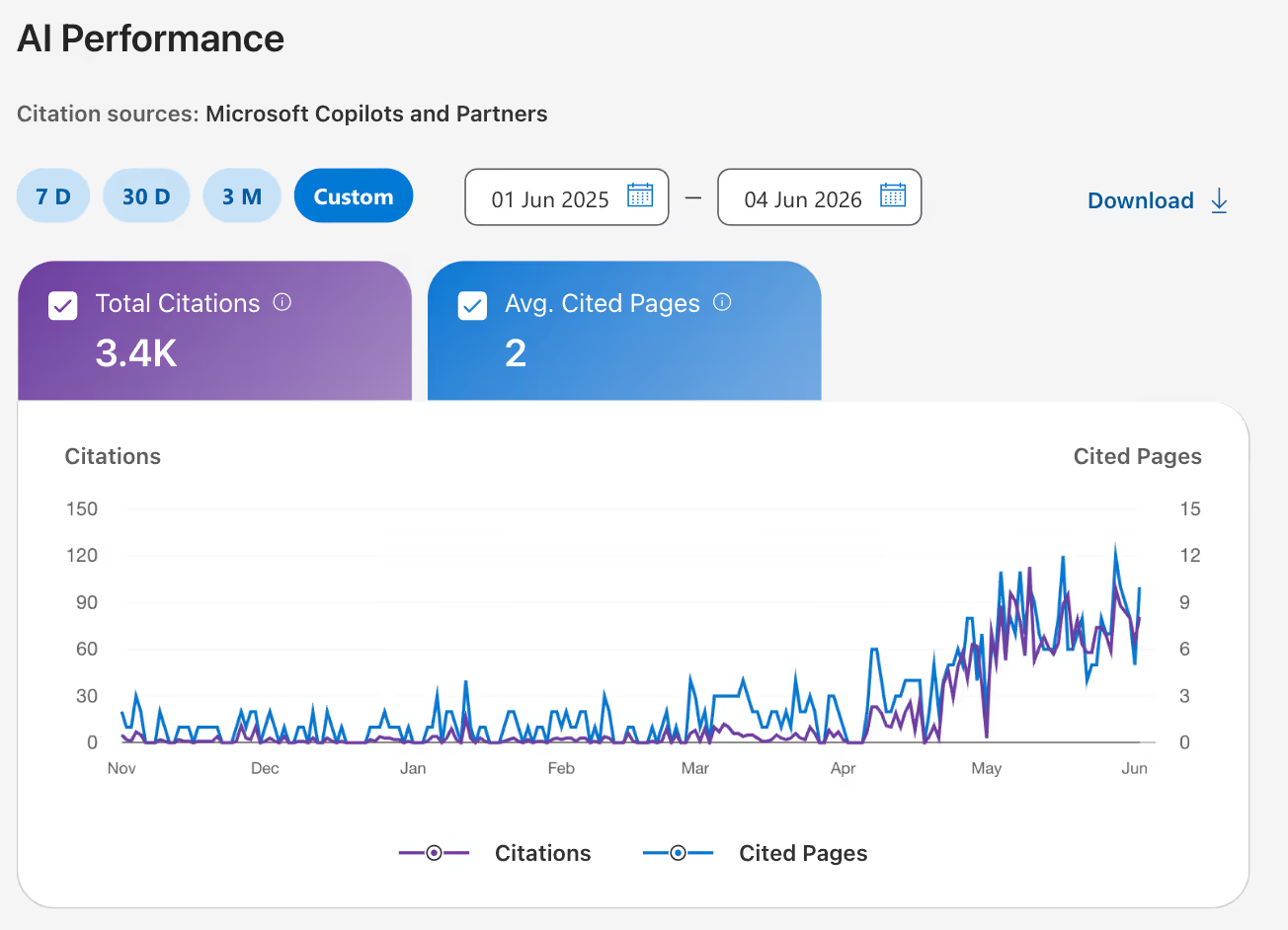
We pay attention because we measure this for clients. Our own guide to Webflow AEO agencies is the most-cited page on our site across Microsoft Copilot and partners, so we watch closely who is actually moving the field versus who is renaming SEO. The names above are the ones moving it.
Common questions
What is an AEO expert?
Someone whose original work on AI search (research, frameworks, experiments, or tools) gets cited by other practitioners. AEO stands for Answer Engine Optimization, the practice of getting a brand quoted inside AI answers from ChatGPT, Perplexity, and Google AI Overviews. Authority in the field is earned by publishing things other people build on, not by claiming the title.
How do I vet an AEO expert before hiring or following them?
Check whether they publish original data or only commentary. Ask how they measure AI visibility (share of voice inside the models, citation counts, AI-sourced conversions) versus relabeled keyword rankings. The people on this list show their methods in the open. Anyone selling secret tactics is a red flag.
Is AEO the same as GEO or AI SEO?
Mostly yes. AEO (Answer Engine Optimization), GEO (Generative Engine Optimization), and “AI SEO” describe the same goal: being cited in AI-generated answers. The term GEO comes from a 2024 Princeton research paper. Different practitioners prefer different labels, and the work overlaps heavily.
Who should I follow first if I only have time for a few?
For data and frameworks, Mike King, Kevin Indig, and Tim Soulo. For the technical mechanics, Dan Petrovic and Andrea Volpini. For ongoing education, Aleyda Solis. That mix covers method, mechanism, and what to actually do.
Methodology and disclosure
Karpi Studio built this list. We curated by contribution to AI search (original research, frameworks, experiments, tools) rather than follower count, and grouped people by what they bring rather than ranking them one to twenty. The main groups are people whose work we cite. The Webflow-native builders section at the end includes us and Sofian Bettayeb, flagged openly because that is the lane we work in. Every role and affiliation was verified as of June 2026, though people move, so check before you cite. This is our honest read of who is defining the field right now. If we missed someone obvious, or got a detail wrong, email pavel@karpi.studio and we will fix it.
For our own take on the agencies doing this work, see Best AI SEO and AEO Agencies for B2B and the Karpi AEO service page.
By Pavel Karpisek. Founder of Karpi Studio, Premium Webflow Enterprise Partner. We build and measure AI search visibility for B2B SaaS, which is why we pay attention to who is actually defining it. Last updated: June 2026.

.avif)